Blog Details

types of nuts used in industrial applications

Types of Nuts Are Used in Industrial Applications

Industrial fastening systems depend on reliable connections, and nuts play a vital role in creating those connections. Although nuts are small components, the right type of nut can significantly affect the stability, strength, and service life of an assembly.

So, how many types of nuts are used in industrial applications? There is no fixed number because industrial nuts are available in many designs, sizes, materials, grades, and finishes. However, some types are used much more frequently than others across construction, PEB structures, machinery, infrastructure, railways, automotive, fabrication, and general engineering.

The most commonly used types include hex nuts, flange nuts, lock nuts, Nylock nuts, dome nuts, coupling nuts, wing nuts.

In this guide, we will explain the major types of nuts used in industrial applications, where they are used, how they differ, and how to choose the right nut for your industrial project.
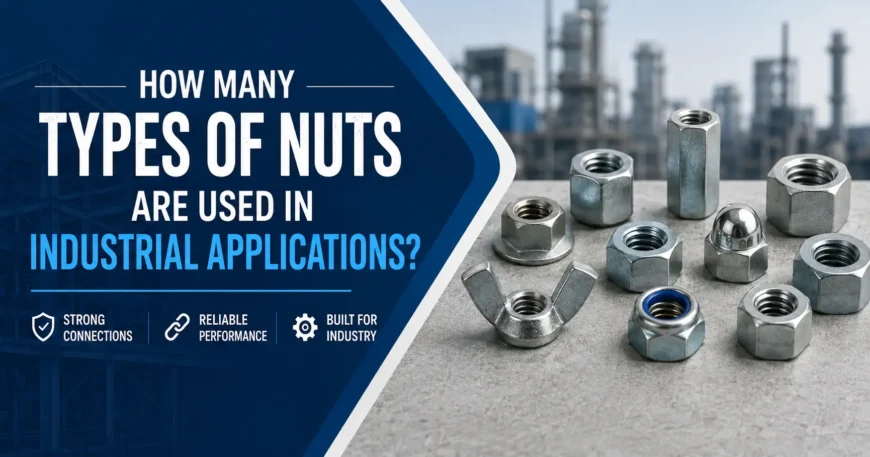

The most commonly used types include hex nuts, flange nuts, lock nuts, Nylock nuts, dome nuts, coupling nuts, wing nuts.

In this guide, we will explain the major types of nuts used in industrial applications, where they are used, how they differ, and how to choose the right nut for your industrial project.

What Are Industrial Nuts?

Industrial nuts are threaded fastening components designed to work with compatible bolts, studs, or threaded rods. When tightened onto a threaded fastener, a nut creates the clamping force needed to hold components securely together.

Depending on the application, industrial nuts can differ in:

  • Shape and design
  • Thread size and pitch
  • Material
  • Mechanical grade
  • Surface finish
  • Locking mechanism
  • Load capacity
  • Installation method

A nut should always be selected as part of a complete fastening system. The nut, bolt, washer, and threaded components need to be compatible with each other and with the requirements of the application.

Request A Quote

Fill all information details to consult

    Why Choose JVS Nut Bolt

    Trusted Allen Bolts Manufacturer in India

    45+ Years Experience Extensive expertise in fastener manufacturing.
    Modern Manufacturing Facility Advanced production technology
    Strict Quality Control Every batch tested before dispatch
    Bulk Production Capacity Medium Carbon Steel
    Head Marking Suitable for large industrial projects
    Competitive Factory Pricing Direct manufacturer rates
    Fast Delivery Across India & UAE Reliable logistics network

    How Many Types of Nuts Are Used in Industrial

    There are numerous nut designs available for industrial use. The exact number depends on how nuts are classified, but the following are some of the most commonly used types of nuts in industrial applications:

    1. Hex Nuts
    2. Flange Nuts
    3. Lock Nuts
    4. Nylock Nuts
    5. Dome Nuts
    6. Coupling Nuts
    7. Wing Nuts

    Each type has a different design and purpose. Let’s look at them in detail.

    How Are Industrial Nuts Classified?

    The types of nuts used in industrial applications can also be classified according to their shape, material, locking mechanism, and finish.

    Classification by Shape

    Common nut shapes include:

    • Hexagonal nuts
    • Flange nuts
    • Dome nuts
    • Wing nuts
    • Coupling nuts
    • Weld nuts

    The shape usually determines how the nut is installed and how it interacts with the assembly.

    Classification by Locking Design

    Some nuts provide standard fastening, while others are designed to resist loosening.

    Examples include:

    • Standard nuts
    • Lock nuts
    • Nylock nuts
    • Specialized locking nuts

    The choice depends on vibration, movement, maintenance requirements, and application conditions.

    Classification by Material

    Industrial nuts can be manufactured using different materials according to application requirements.

    Common options include:

    • Mild steel
    • High tensile steel
    • Stainless steel where specified

    For heavy-duty industrial fastening, material and mechanical properties should be compatible with the corresponding bolt and application.

    Classification by Surface Finish

    Industrial nuts can also be supplied with different surface finishes.

    Depending on requirements, finishes may include:

    • Zinc plating
    • Hot-dip galvanizing
    • Black finish
    • Self colour
    • Nickel plating
    • Chrome finish
    • Other specified coatings

    The right finish is particularly important for outdoor and corrosive environments.

    Frequently Asked Questions About Types of Nuts Used in Industrial Applications - Frequently Asked Questions About Types of Nuts Used in Industrial Applications - Frequently Asked Questions About Types of Nuts Used in Industrial Applications -

    There are many types of nuts used in industrial applications, and there is no single fixed number. Common types include hex nuts, flange nuts, lock nuts, Nylock nuts, dome nuts, coupling nuts, wing nuts,
    The most commonly used industrial nuts include hex nuts, flange nuts, lock nuts, Nylock nuts, coupling nuts, and weld nuts. The right type depends on the application and fastening requirements.
    A standard hex nut is commonly used with a compatible hex bolt. The nut should match the bolt's diameter, thread type, pitch, and required mechanical properties.
    Hex nuts, flange nuts, and suitable locking solutions may be used in PEB structures depending on the structural design, bolt specifications, grade, and project requirements.
    Yes. JVS Nut Bolt supports bulk orders for distributors, contractors, infrastructure projects, industrial buyers, and OEM customers.

    Leave A Comment

    Cart
  • Your cart is empty Browse Shop
    Select the fields to be shown. Others will be hidden. Drag and drop to rearrange the order.
    • Image
    • SKU
    • Rating
    • Price
    • Stock
    • Availability
    • Add to cart
    • Description
    • Content
    • Weight
    • Dimensions
    • Additional information
    Click outside to hide the comparison bar
    Compare
    Call Now Button